News

YOUROPE at IOM Summer School: Amplifying Migrant Voices Through Community-Led Research

10 September 2025

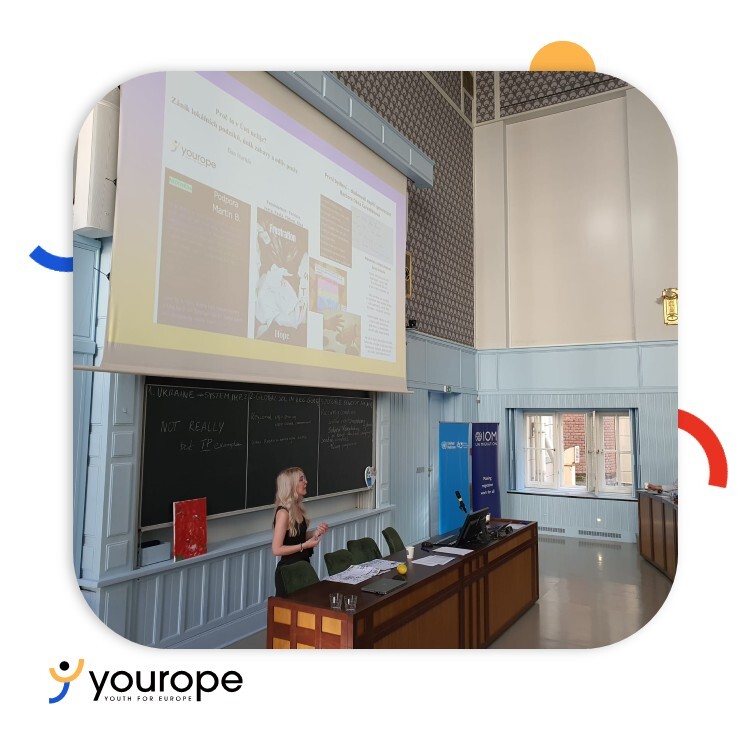
What does it mean to study migration when the researchers themselves have experienced it? This question sat at the centre of YOUROPE’s contribution to the International Organization for Migration (IOM) Summer School in Prague, where the project’s participatory approach sparked new thinking about how migration research is taught and conducted.

Patricie Kyslíková and Salim Murad from the University of South Bohemia led an engaging workshop on Community-Led Research and Action (CLRA), presenting research outcomes from young researchers participating in the YOUROPE project. They explored how CLRA methodologies can enrich migration studies curricula, including the prestigious Erasmus Mundus EMMIR programme — demonstrating that this approach does not just study migration from the outside. It amplifies the voices of those who have lived it.

Creative methods that shift the narrative

The workshop introduced participants to a range of practical CLRA techniques through which young researchers reclaim their own narratives and challenge stereotypes. These included mapping public spaces to reframe their environments; creating songs that express personal stories; and developing photo and video projects that shift perspectives and challenge assumptions.

What distinguishes these methods is that they place young people in control. Rather than being the subjects of someone else’s research, they become the researchers — asking the questions that matter to them, in forms that feel authentic.

From personal stories to systemic change

CLRA projects serve a dual purpose. They offer young people experiencing marginalisation a space to be heard and to build agency, while simultaneously generating powerful advocacy tools for broader social change. In migration contexts especially, this matters: the voices most absent from policy discussions are often those with the most at stake.

The workshop made clear that changing who holds the research tools changes the stories that get told — and the IOM Summer School offered a compelling audience to hear them.

Framework and Toolkit

Youth-informed theory and a practical EU Citizenship Toolkit
 
Where the road leads: a grassroots-informed theoretical framework on European citizenship and democracy, built from the ground up on youth perspectives, and a youth-centred EU Citizenship Toolkit that turns these insights into practical resources for educators, youth workers and young people themselves. Results are expected in 2027.

Main Survey

Measuring what matters, in language grounded in youth voices
 
The findings of the exploratory survey feed directly into the design of the main survey: a larger instrument grounded in young people’s own language, experiences and priorities. Instead of asking young people to respond to researchers’ categories, the main survey measures what matters in terms young people themselves have shaped.

Exploratory Youth Survey

Learning from young people in their own words
 
Rather than starting from predefined assumptions, YOUROPE wants to learn directly from young people in their own words. This exploratory survey invites young people across Europe to share their views and experiences on citizenship, democracy, participation, inclusion and digital life. It is anonymous, voluntary, available in nine languages, and takes 10–15 minutes: an important first step in a co-creation process that places youth voices at the centre of the research.

Research Foundations

Policy analysis and systematic literature review

Every roadmap needs a starting point. WP3 began with two parallel strands of research: a policy analysis mapping how youth citizenship and democratic participation are addressed across Europe, and a systematic literature review of what existing research tells us about young people, democracy and participation. Together, these form the evidence base of WP3 and are published as part of the WP3 report.

Dialogue Map

Turning findings into conversations on the dimensions of democratic life 
 
Building on the research findings, the team in Augsburg developed the Dialogue Map: a tool that turns what we learned into conversations. It is organised around key dimensions of democratic life, from youth voice and European citizenship to participation, inclusion and digital citizenship, each with a key question and discussion prompts to open up dialogue with and among young people.

D6 · Dimension

Digital Citizenship

Digital environments as civic and political space

KEY QUESTION
What does it mean to be a citizen online?
DISCUSSION PROMPTS

D5 · Dimension

Inclusion and Justice

Structural inequalities and intersecting identities

KEY QUESTION

Do you think everyone has equal opportunities to participate in society?

DISCUSSION PROMPTS

D4 · Dimension

Participation and Power

Procedural vs. substantive participation

KEY QUESTION

When does participation actually make a difference in your life?

DISCUSSION PROMPTS

D3 · Dimension

European Citizenship

Europe as lived democratic space

KEY QUESTION
What does ‘Europe’ mean to you in your everyday life?
DISCUSSION PROMPTS

D2 · Dimension

Youth Voice & Knowledge

Young people as knowers, not just learners

KEY QUESTION

Do you feel that young people’s voices and experiences are taken seriously?

DISCUSSION PROMPTS