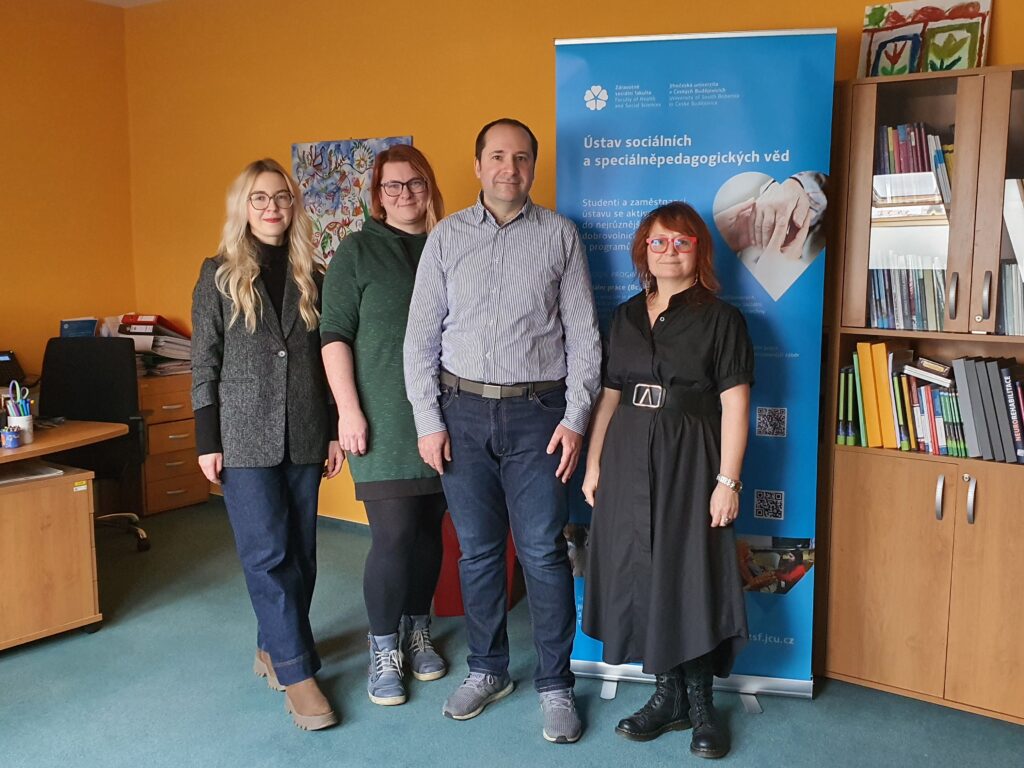
YOUROPE project at the University of South Bohemia is based at the Institute of Social and Special-paedagogical Sciences of the Faculty of Health and Social Sciences. The Faculty is an educational institution that focuses on the health and social care field. Motto of the faculty is “We teach people to help.”
At the Institute, we train future social workers through a variety of bachelor’s and master’s study programs. These include the bachelor’s degree program in Social Policy and Social Work, as well as specialized tracks in Social Work in Public Administration and Social Work with a Focus on Minorities, Migrants, and the Roma Community. While all these programs offer a strong theoretical foundation, practical training is a significant part of the curriculum. This hands-on experience and supervision are provided in collaboration with the Institute’s clinical workplaces and a broad network of partner NGOs.
The Institute is also a partner in the EMMIR (European Master in Migration and Intercultural Relations) joint degree program (www.emmir.org). For more information, please visit the faculty website or the Institute’s website.
The Department of Social Pedagogy and Social Rehabilitation is the oldest department of social pedagogy in Poland, established in 1945. It is a proud member of EASSW, IASSW, and ERIS. The department’s main research areas include issues related to homelessness and social exclusion, disadvantaged neighbourhoods, foster care, strategies for integrated urban redevelopment, and social and epistemic justice. Its particular expertise lies in Participatory Action Research, Political Social Work, Youth Work, Social Education, and Community Development.
The Institute is involved in every aspect of the project, with a particular focus on amplifying the voices of young people in the Czech Republic—especially those at risk of social exclusion and marginalization. It will also highlight the vital roles of social workers, social pedagogues, and civic education teachers in helping young people realize their potential and in bringing to the forefront voices that might otherwise go unheard in public debate.
Framework and Toolkit
Youth-informed theory and a practical EU Citizenship Toolkit
Where the road leads: a grassroots-informed theoretical framework on European citizenship and democracy, built from the ground up on youth perspectives, and a youth-centred EU Citizenship Toolkit that turns these insights into practical resources for educators, youth workers and young people themselves. Results are expected in 2027.
Measuring what matters, in language grounded in youth voices
The findings of the exploratory survey feed directly into the design of the main survey: a larger instrument grounded in young people’s own language, experiences and priorities. Instead of asking young people to respond to researchers’ categories, the main survey measures what matters in terms young people themselves have shaped.
Rather than starting from predefined assumptions, YOUROPE wants to learn directly from young people in their own words. This exploratory survey invites young people across Europe to share their views and experiences on citizenship, democracy, participation, inclusion and digital life. It is anonymous, voluntary, available in nine languages, and takes 10–15 minutes: an important first step in a co-creation process that places youth voices at the centre of the research.
Every roadmap needs a starting point. WP3 began with two parallel strands of research: a policy analysis mapping how youth citizenship and democratic participation are addressed across Europe, and a systematic literature review of what existing research tells us about young people, democracy and participation. Together, these form the evidence base of WP3 and are published as part of the WP3 report.
Turning findings into conversations on the dimensions of democratic life
Building on the research findings, the team in Augsburg developed the Dialogue Map: a tool that turns what we learned into conversations. It is organised around key dimensions of democratic life, from youth voice and European citizenship to participation, inclusion and digital citizenship, each with a key question and discussion prompts to open up dialogue with and among young people.