News

Youth Voices at the Council of Europe: YOUROPE at the International Day for the Eradication of Poverty

22 October 2025

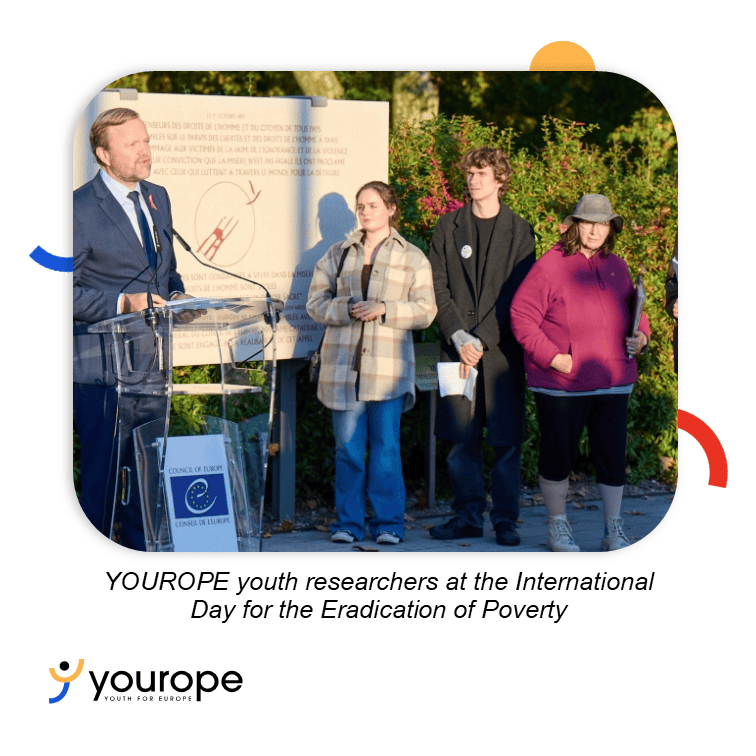
On the International Day for the Eradication of Poverty, young researchers from the YOUROPE project stood before the Council of Europe in Strasbourg — not as observers, but as active participants in a ceremony dedicated to those whose voices are most often unheard.

Oliwer and Wiktoria, young researchers from the YOUROPE project, joined Deputy Secretary General Bjørn Berge and other speakers at the ceremony, where they read a powerful poem written by a young immigrant from Senegal. Their presence represented something larger than a single event: a statement about who belongs in spaces where Europe’s future is discussed.

Behind the scenes and on stage


The young researchers’ contribution went beyond the podium. Working behind the scenes, they also managed the Facebook live stream for the ceremony, ensuring its message reached wider audiences beyond the room in Strasbourg. In doing so, they embodied the YOUROPE principle that youth participation is not merely symbolic — it is practical, skilled, and consequential.

The ceremony was organised by the Conference of INGOs of the Council of Europe, with the participation of YOUROPE, ATD Alsace, and Caritas, bringing together diverse voices in solidarity with people experiencing poverty. This year’s UN theme — “Ending social and institutional maltreatment by ensuring respect and effective support for families” — resonated directly with the project’s community-led work.

Democracy as practice, not just principle

As UN Secretary-General António Guterres stated, poverty is not a personal failure but a systemic one — a denial of dignity and human rights. Through Community-Led Research and Action, YOUROPE approaches this reality not with top-down solutions but with the belief that the people closest to these challenges are best placed to name and address them.

From documenting key events to sharing overlooked stories, young people in the YOUROPE project practise democracy rather than simply studying it. When youth participate, democracy grows stronger.
Framework and Toolkit

Youth-informed theory and a practical EU Citizenship Toolkit
 
Where the road leads: a grassroots-informed theoretical framework on European citizenship and democracy, built from the ground up on youth perspectives, and a youth-centred EU Citizenship Toolkit that turns these insights into practical resources for educators, youth workers and young people themselves. Results are expected in 2027.

Main Survey

Measuring what matters, in language grounded in youth voices
 
The findings of the exploratory survey feed directly into the design of the main survey: a larger instrument grounded in young people’s own language, experiences and priorities. Instead of asking young people to respond to researchers’ categories, the main survey measures what matters in terms young people themselves have shaped.

Exploratory Youth Survey

Learning from young people in their own words
 
Rather than starting from predefined assumptions, YOUROPE wants to learn directly from young people in their own words. This exploratory survey invites young people across Europe to share their views and experiences on citizenship, democracy, participation, inclusion and digital life. It is anonymous, voluntary, available in nine languages, and takes 10–15 minutes: an important first step in a co-creation process that places youth voices at the centre of the research.

Research Foundations

Policy analysis and systematic literature review

Every roadmap needs a starting point. WP3 began with two parallel strands of research: a policy analysis mapping how youth citizenship and democratic participation are addressed across Europe, and a systematic literature review of what existing research tells us about young people, democracy and participation. Together, these form the evidence base of WP3 and are published as part of the WP3 report.

Dialogue Map

Turning findings into conversations on the dimensions of democratic life 
 
Building on the research findings, the team in Augsburg developed the Dialogue Map: a tool that turns what we learned into conversations. It is organised around key dimensions of democratic life, from youth voice and European citizenship to participation, inclusion and digital citizenship, each with a key question and discussion prompts to open up dialogue with and among young people.

D6 · Dimension

Digital Citizenship

Digital environments as civic and political space

KEY QUESTION
What does it mean to be a citizen online?
DISCUSSION PROMPTS

D5 · Dimension

Inclusion and Justice

Structural inequalities and intersecting identities

KEY QUESTION

Do you think everyone has equal opportunities to participate in society?

DISCUSSION PROMPTS

D4 · Dimension

Participation and Power

Procedural vs. substantive participation

KEY QUESTION

When does participation actually make a difference in your life?

DISCUSSION PROMPTS

D3 · Dimension

European Citizenship

Europe as lived democratic space

KEY QUESTION
What does ‘Europe’ mean to you in your everyday life?
DISCUSSION PROMPTS

D2 · Dimension

Youth Voice & Knowledge

Young people as knowers, not just learners

KEY QUESTION

Do you feel that young people’s voices and experiences are taken seriously?

DISCUSSION PROMPTS